

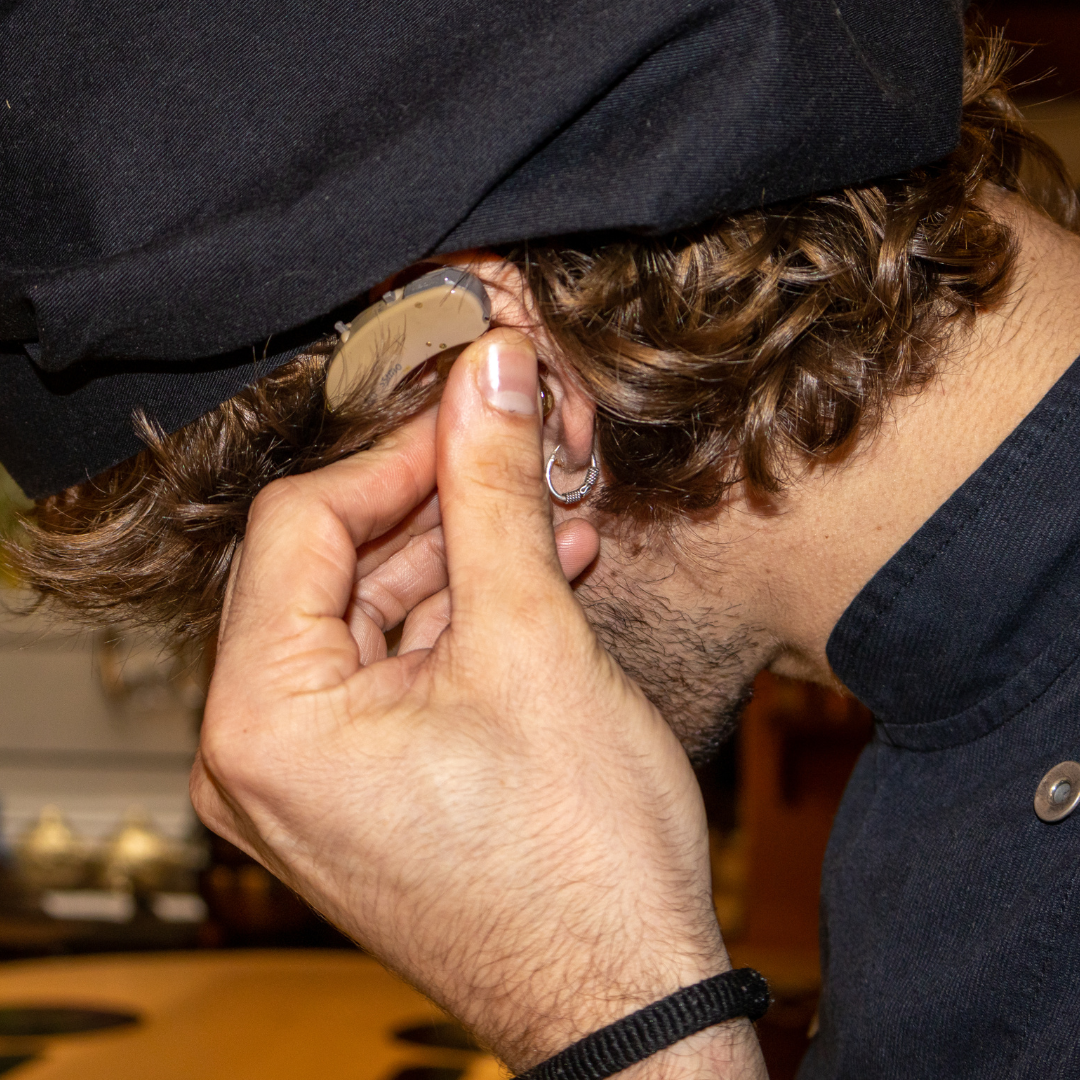
Group discussions in restaurants often become difficult to comprehend when room acoustics compete with your focus and hearing. Our practice provides targeted diagnostics to evaluate hearing in quiet atmospheres as well as complex noise environments. Once the diagnostic etiology of your difficult hearing is established, we implement personalized clinical and technological strategies.
Why Can I Hear Normally but Struggle to Listen in a Restaurant?
A quiet setting creates an optimal signal-to-noise ratio, ensuring the conversational partner’s voice rises cleanly above ambient sounds. Dining rooms present an unfavorable acoustic reversal of this dynamic. Layered diner voices, kitchen activity, foreground music, and room reverberation muddy speech signals, requiring intense mental strain to follow dialogue.
This symptom pattern often reflects underlying high-frequency hearing loss, central processing dysfunction, or physiological aging of the auditory nerve. Dim lighting, physical tiredness, conversational distance, and divided attention exacerbate these listening deficits. Some people have normal results on a basic hearing test but still perform poorly on speech-in-noise testing. Difficulty in restaurants deserves evaluation even when everyday hearing seems normal.
Diagnostic Protocols for High-Frequency Hearing Loss
We begin by reviewing your history of communication difficulties, prior noise exposures, ringing or tinnitus, pharmaceuticals, and unilateral symptoms.
Diagnostic pure-tone audiometry establishes the softest auditory thresholds you can perceive across standardized frequencies via air and bone conduction pathways. High-frequency hearing loss commonly presents on the audiogram as a characteristic precipitous drop in the higher frequency ranges. Diagnostic evaluations may also integrate acoustic tympanometry to check middle-ear pressure alongside word-recognition testing to evaluate speech processing.
Because a quiet booth does not recreate a busy dining room, speech-in-noise testing can add valuable information. This procedure gauges speech-discrimination accuracy while competing multi-source noise becomes incrementally louder. Together, these results show whether the problem involves audibility, speech clarity, background-noise processing, or a combination of factors.
Auditory Processing Disorders: Impact on Adult Communication
An auditory processing disorder compromises how the central auditory pathways and brain decode incoming acoustic information. The ears may detect tones at expected levels, but the brain may have difficulty organizing competing signals, distinguishing similar speech sounds, or following rapid conversation. Our protocol begins by thoroughly testing peripheral hearing before determining if a specialized central auditory-processing battery or interdisciplinary referral is warranted.
Effective Techniques to Hear Better in Noisy Surroundings
Small changes can improve the signal reaching your ears and provide clearer visual cues. When planning to dine out, select restaurants with calmer atmospheres or arrange reservations during off-peak hours. Facilities equipped with upholstered booths, acoustic baffles, fabric curtains, carpeted floors, and soft materials prove far easier on hearing than minimalist, hard-tiled spaces.
Practical seating strategies in the dining room:
- Select a secluded table situated away from prep kitchens, crowded bar stations, loudspeaker zones, and large parties.
- Position yourself with your back toward a solid partition to dampen intrusive background noise from behind.
- Face your conversation partners in good lighting.
- Keep the distance between speakers as short as comfortably possible.
- Direct your better-performing ear toward the companion you most need to understand.
- Encourage speakers to rephrase key information rather than simply repeating unparsed words louder.
- Verifiably confirm essential conversational facts instead of bluffing comprehension.
- Take brief listening rests outside or in quiet hallways when mental fatigue emerges.
- Request that friends speak with crisp clarity rather than speeding through dialogue.
- Shouting creates acoustic distortion that actively compromises speech understanding rather than helping.
Assistive Hearing Tools and Technology for Complex Acoustic Environments
Optimal technological solutions depend entirely on the etiology of your symptoms, target acoustic spaces, and whether measurable hearing loss exists. Prescription hearing aids fitted by an audiologist leverage directional microphone arrays, advanced digital noise reduction, and dedicated restaurant programs to focus on frontal speech while dampening background sound. They still require realistic expectations because no device can remove every unwanted voice.
Pairing your devices with a remote wireless microphone generates a substantial improvement in the direct signal-to-noise ratio. Clipped near the speaker’s mouth or set nearby, the transmitter sends voice signals wirelessly to matched hearing aids or a receiver. This targeted setup effectively neutralizes the negative impacts of room distance and interfering background noise.
Other clinically valuable tools include:
- Portable table microphones for managing multi-speaker dinner conversations
- Hearing-loop telecoils that stream clean audio in loop-equipped establishments
- Real-time smartphone speech-to-text transcription and live-captioning apps
- Modern wireless hearables delivering directional beamforming and sound enhancement
- Decibel-level applications and restaurant rating guides for finding quiet tables
We can compare options, confirm compatibility, and teach you how to use the selected device.
How Can a Doctor Help with Hearing in Loud Places?
A professional clinical assessment moves beyond basic baseline statements like “I hear fine in quiet rooms.” We can review the places, speakers, and noise levels that cause problems and select tests that reflect those concerns. Testing routinely combines pure-tone audiometry, middle-ear impedance tests, speech discrimination, and speech-in-noise measures. Central auditory-processing testing is considered whenever clinical intake and initial test outcomes point toward higher-order deficits.
Abrupt auditory reductions, unilateral hearing shifts, or rapid functional deterioration require prompt assessment by an ear, nose, and throat physician. Individualized diagnostic care pinpoints the precise physiological etiology rather than merely blaming restaurant noise for communication struggles.
Arrange a Hearing Evaluation With Us Now
If dining in loud spaces leaves you feeling isolated, fatigued, or guessing at missed speech, contact us to schedule a thorough hearing evaluation. We can explore ways to help with hearing in noisy environments with hearing-aid adjustments, assistive tools, or rehabilitation options that may fit your needs.
Reach out to our audiology clinic today to schedule an evaluation and begin enjoying clear, effortless conversations.